Small Groups Big Learning


Timeline: 3 weeks

Model: Dick & Carey Systems Approach Model

Responsibilities: Instructional Design and Facilitation of the Workshop

Tools: PowerPoint, Zoom
Small Groups - Big Learning was one of a series of workshops for faculty at Notre Dame de Namur University (NDNU). The workshop focused on the driving question "What approaches and specific techniques can higher education instructors use to overcome group-learning challenges and foster collaboration skills and critical thinking to maximize both student learning and satisfaction?". I was tasked to analyze the learning needs, identify research-based strategies to foster collaborative learning and course examples at NDNU and beyond, collaborate with instructors to present their course examples, design engagement, and facilitate the workshop.

THE CHALLENGE
As the institution was transitioning from fully in-person to online synchronous and asynchronous learning, many instructors struggled with implementing effective group work in distance learning. A common challenge was students’ preference for individual work, which hindered meaningful learner-to-learner collaboration. This workshop aimed to support faculty in overcoming these obstacles and gain practical insights into structuring group work to meet learning outcomes, address common student concerns, and maximize the benefits of peer interaction in online environments.

DESIGN & DEVELOPMENT
LEARNING OBJECTIVES
The primary goal of this workshop was to equip faculty members with research-based strategies that foster collaborative learning and practical methods to address associated challenges. The learning objectives focused on identifying and understanding collaborative learning strategies in higher education, analyzing factors that hinder collaborative learning in online courses, and evaluating methods to address the associated challenges.

Workshop Learning Objectives. Screenshot.
INSTRUCTIONAL & LEARNING STRATEGIES
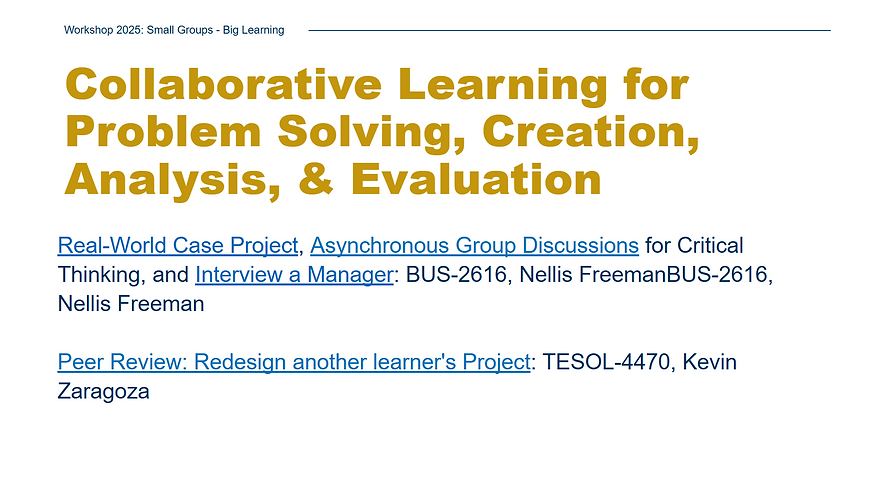
The workshop followed the fishbowl technique, demonstrating one of the collaborative strategies that faculty could implement in their courses. A small group of instructors I collaborated with during course development, and I discussed strategies of collaborative learning and ways to mitigate common challenges in online learning, while the bigger group of participants observed the discussion.
While designing this workshop, I identified key collaborative learning strategies, drawing on examples from courses I worked on. These examples demonstrated the practical implementation of collaborative learning strategies, helping participants reflect on their teaching practices and make connections. More specifically, the examples showcased ways to foster constructive interactions among students and the instructor and engage learners in meaningful group work that helps them deepen their understanding, complete complicated academic tasks, solve problems, and develop interpersonal and critical thinking skills. Close collaboration with and active participation of the instructors in the workshop ensured a cohesive presentation, providing a comprehensive overview of effective practices.
At the end of the workshop, I provided instructors with a list of collaborative learning techniques for higher education that included step-by-step guidance on preparing and implementing these strategies for in-person and online synchronous and asynchronous learning.

IMPLEMENTATION & EVALUATION
The workshop was hosted on Zoom, and a recording was uploaded to our SharePoint site. This way, the participants were able to attend from their places, giving flexibility to others to watch it at their convenience. A survey was conducted at the end of the workshop to receive feedback from the participants on its effectiveness.